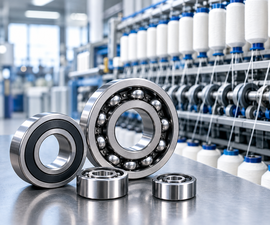
Industrial Bearings for Spinning Machines: Types, Applications and Buying Guide
Bearings are essential components in textile and spinning machinery. They play a key role in supporting rotating shafts, reducing friction, ensuring smooth movement, and maintaining the reliable operation of industrial equipment.
In spinning mills, machines often operate continuously at high speeds and under demanding working conditions. The quality and performance of their components directly affect production efficiency, machine reliability, and maintenance costs.
Choosing the right bearing can help reduce vibration, prevent excessive heat generation, minimize component wear, and avoid unexpected production interruptions.
In this article, we explore the main types of industrial bearings, their applications in spinning machinery, and the most important factors to consider when purchasing replacement bearings.
1. What Is an Industrial Bearing?
An industrial bearing is a mechanical component designed to support rotating or moving parts while reducing friction between them.
Bearings allow shafts and other machine components to rotate smoothly while supporting radial loads, axial loads, or a combination of both.
2. Common Types of Industrial Bearings
Deep Groove Ball Bearings
Widely used in industrial machinery, these bearings are suitable for high-speed applications and can accommodate both radial and axial loads.
Self-Aligning Ball Bearings
Designed to accommodate a certain degree of shaft misalignment, making them suitable for applications with alignment variations.
Angular Contact Ball Bearings
Designed to support combined radial and axial loads, particularly in applications requiring high precision.
Cylindrical Roller Bearings
Suitable for applications involving relatively heavy radial loads.
Spherical Roller Bearings
Designed to accommodate heavy loads and compensate for shaft misalignment.
Thrust Bearings
Specifically designed to support axial loads acting parallel to the shaft.
3. Applications of Bearings in Spinning Machinery
Bearings are used in various sections of spinning machinery, including:
* Ring Spinning Machines: Used in rotating assemblies, spindle-related components, and roller support systems.
* Comber Machines: Used in rotating shafts, rollers, and mechanical transmission assemblies.
* Carding Machines: Used in the main cylinder, licker-in, doffer, and other rotating sections.
* Draw Frame Machines: Used in roller assemblies and other rotating components.
* Autoconer Machines: Used in winding units, drive systems, and rotating assemblies.
The correct bearing type must always be selected according to the machine manufacturer’s specifications and the operating requirements of each installation position.
4. Important Factors When Selecting Bearings
Selecting the right bearing is essential for maintaining machinery performance and reducing maintenance problems.
Before purchasing a replacement bearing, consider the following factors:
* Machine Model and Manufacturer: Check the exact machine model and original bearing specifications.
* Bearing Dimensions: Verify the inner diameter, outer diameter, and width.
* Load Capacity: Consider the radial and axial loads applied to the bearing.
* Rotational Speed: Select a bearing suitable for the machine’s operating speed.
* Lubrication: Check the required lubricant type and lubrication intervals.
* Sealing and Protection: Consider dust, lint, moisture, and other environmental contaminants.
* Product Quality and Authenticity: Choose genuine, high-quality bearings from reliable suppliers.
5. Why Is Bearing Quality Important in Spinning Mills?
Using suitable, high-quality bearings can contribute to:
* Smooth and stable machine operation
* Reduced friction and vibration
* Improved operational reliability
* Lower risk of premature bearing failure
* More efficient maintenance planning
* Reduced unexpected production downtime
Bearing service life also depends on correct installation, proper lubrication, operating conditions, and regular maintenance.
6. How to Choose the Right Bearing for Your Machine
To identify and supply the correct bearing, it is important to provide accurate technical information.
When requesting a bearing, please provide:
* Bearing part number or designation
* Machine model and manufacturer
* Inner diameter, outer diameter, and width
* Required quantity
* Clear photos of the bearing markings, if available
Please note that bearings with identical dimensions are not necessarily interchangeable. Their internal design, load capacity, clearance, and operating specifications must also be considered.
7. Genuine SKF Bearings at Kashan Tex Trading
Kashan Tex Trading specializes in supplying spare parts for textile and spinning machinery.
We are proud to offer genuine SKF bearings for industrial and spinning machinery applications.
We focus on product quality, reliable supply, and competitive pricing to meet the spare parts requirements of textile manufacturers and industrial customers.
Whether you need bearings for ring spinning machines, combers, carding machines, draw frames, autoconers, or other industrial equipment, our team is ready to assist you.
For inquiries about availability and pricing, please contact us with your bearing part number, machine model, and required quantity.
Kashan Tex Trading
Genuine SKF Bearings – Quality You Can Trust
Phone / WhatsApp: +98 913 030 3702
Instagram: @Kashantex
Contact us for more information and bearing supply inquiries.